Hop Latent Viroid (HLVd) – Testing for Cannabis

The Hop Latent Viroid (HLVd) is a plant-pathogenic RNA viroid originally known from hops, but which has since been detected in Cannabis sativa/indica and represents an economically significant pathogen (Bektas et al., 2019; Warren et al., 2019). HLVd often does not initially cause any clear symptoms and therefore frequently goes unnoticed for a long time. In cannabis, infection is associated with so-called “Dudding Disease” (from the English word “dud”: defective product), which leads to stunted growth, reduced vitality, diminished flowering, and lower cannabinoid and terpene content, resulting in losses in yield and quality (Adkar-Purushothama et al., 2023; Attalah et al., 2024).
Early detection is particularly important for commercial and breeding operations, as HLVd can spread primarily through infected plant material, tools, hands, and mechanical contact. An untreated infestation can spread rapidly throughout the crop and cause significant economic damage.
Our laboratory offers detection of Hop Latent Viroid (HLVd) using real-time reverse transcriptase PCR (RT-qPCR) in leaves and roots. This method is considered a highly sensitive and specific standard for the diagnosis of RNA viroids. This allows infections to be reliably detected at an early stage, before visible symptoms appear. Regular screening protects your production, ensures consistent quality, and minimizes economic risks.
Rely on precise diagnostics before damage occurs.
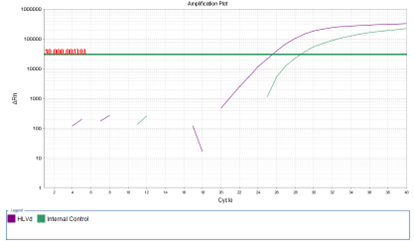
Illustration of an RT-qPCR analysis of HLVd-infected plant material
Positive samples show clear amplification of an HLVd-specific nucleic acid sequence (purple) in the RT-qPCR. Successful detection of the internal control (green) confirms that the RT-qPCR was performed correctly and that the assay is valid.
If you have further questions, feel free to contact us.